A number of academic bloggers have been posting lately about the New York Times article about writing for free: columnists and such being asked to write for "exposure," to the point where it seems like writing is almost never compensated. And, of course, there was the dust-up surrounding the editorial staffer who called scientist Danielle Lee an "urban whore" because she politely declined to write a column for free.
In general, we academics do a lot of writing more or less for "free", simply because it's how we get/keep/get promoted in our day jobs, which do pay. Or, as one senior colleague at another university put to to me when I noted that I wasn't going to see one red cent from my first book, "No, this book will make you more money than anything else you ever write... because this is the book that gets you tenure." Fair enough. But the bulk of informally kinda-sorta-compensated writing that we all do simply underscores why so many of us are not interested in taking on additional non-paying gigs.
All this is a long preface and prelude to saying that last week, something like three years after my book was published, I was notified of my first. royalties. ever.
How much? Well, let's just say that this amount plus seventy-nine cents would buy me one (1) full-priced copy of my own (hardcover) book. Still, that's more than I ever expected to make.
And it makes me think that I ought to start writing books about the knights templar.
Showing posts with label First Book Chronicles. Show all posts
Showing posts with label First Book Chronicles. Show all posts
Tuesday, October 29, 2013

Tuesday, April 3, 2012
The Book Review Strikes Back
I don't normally do book reviews. At least, I haven't in the past. For real: I'm finishing my ninth year post-Ph.D., and I've done a total of five book reviews my entire career, and that's including the one I did in grad school. One reason for this is that I'd just rather spend my time writing my own stuff. But really, a big reason is that I just never felt qualified to review someone else's book. What could I know?
Recently, however, things have changed. I know something about a few fields of inquiry. I know how to write a review, and what readers need. Most of all, after writing my own book, I know what a book ought to look like.
Since arriving at this newly confident place a couple years ago, I've had the opportunity to review one really excellent book. I like to think that I "got" the thing that was really cool about the book, and that I communicated it well to readers. But last month, I also put those skills to use on a book that I didn't think was as well put-together.
Let me tell you, it's a lot easier to write a review of a really excellent book.
With this second book, I found myself struggling to balance my professional mandate to write a review that was honest about the book's strengths and weaknesses with a personal desire to be... nice. "How would you feel if someone wrote this about your book?", that little voice in my head said. "Surely you can find a way to soften that a bit?" said a voice that sounded a lot like my mother. "Are you sure you know what you're talking about here? After all, you work on field A, and this is really A-prime" said another voice that sounded like the one grad school professor who terrified the crap out of me in my orals. "If you can't write a nice review, maybe you should just send it back and let someone else do the review" said a little girl's voice hiding behind the door. And, most doubt-inducing of all was the voice that seemed to come from everywhere: "What if the author's tenure ends up riding on this review?"
So, I sent my draft to Voice of Reason (who had recently asked me for feedback on a similar review she was writing). And she read it, and helped me shape it. The result was professional in tone, and spent some time pointing out the two best features of the book. But it was also critical where it needed to be critical -- again, with a professional tone, but clearly critical. "How would I feel if I got this review?", I asked myself again, in my own voice, and this time I tried to answer the question. I decided that I wouldn't be happy. But I also wouldn't be devastated or personally wounded. And I also decided that I'd put enough in there for a tenure committee to read it however they were inclined to read it anyway. And I sent it off.
And today, I got an e-mail from an editorial assistant from the same publication, thanking me for the review, and also letting me know that they had just received back a review of my book that they were going to publish soon... written by the author of the book I had just reviewed.
I'm think I'm just going to think of this as if it were a theatrical farce, happening to someone else, and sit back and laugh. Because that's really the only thing to do at this point.
Recently, however, things have changed. I know something about a few fields of inquiry. I know how to write a review, and what readers need. Most of all, after writing my own book, I know what a book ought to look like.
Since arriving at this newly confident place a couple years ago, I've had the opportunity to review one really excellent book. I like to think that I "got" the thing that was really cool about the book, and that I communicated it well to readers. But last month, I also put those skills to use on a book that I didn't think was as well put-together.
Let me tell you, it's a lot easier to write a review of a really excellent book.
With this second book, I found myself struggling to balance my professional mandate to write a review that was honest about the book's strengths and weaknesses with a personal desire to be... nice. "How would you feel if someone wrote this about your book?", that little voice in my head said. "Surely you can find a way to soften that a bit?" said a voice that sounded a lot like my mother. "Are you sure you know what you're talking about here? After all, you work on field A, and this is really A-prime" said another voice that sounded like the one grad school professor who terrified the crap out of me in my orals. "If you can't write a nice review, maybe you should just send it back and let someone else do the review" said a little girl's voice hiding behind the door. And, most doubt-inducing of all was the voice that seemed to come from everywhere: "What if the author's tenure ends up riding on this review?"
So, I sent my draft to Voice of Reason (who had recently asked me for feedback on a similar review she was writing). And she read it, and helped me shape it. The result was professional in tone, and spent some time pointing out the two best features of the book. But it was also critical where it needed to be critical -- again, with a professional tone, but clearly critical. "How would I feel if I got this review?", I asked myself again, in my own voice, and this time I tried to answer the question. I decided that I wouldn't be happy. But I also wouldn't be devastated or personally wounded. And I also decided that I'd put enough in there for a tenure committee to read it however they were inclined to read it anyway. And I sent it off.
And today, I got an e-mail from an editorial assistant from the same publication, thanking me for the review, and also letting me know that they had just received back a review of my book that they were going to publish soon... written by the author of the book I had just reviewed.
I'm think I'm just going to think of this as if it were a theatrical farce, happening to someone else, and sit back and laugh. Because that's really the only thing to do at this point.
Thursday, May 19, 2011
Confronting the Hard Numbers, and I Feel (sorta) Fine
Today I got an update on the hard numbers on the first run of my book, now out a year. Of the whole (smallish) print run, about 40% have sold. 50% remain. The rest, I assume, have been given away by the press as review or author's or prize copies (which, I have to admit, is pretty cool).
Honestly, there is a part of me that is disappointed that this book hasn't been a runaway success, selling out its first print run in less than a year.
Another part of me acknowledges that 40% is not too bad in this day and age.
Another part hopes that sales will go up when reviews really start coming out (only one so far, that I know of).
But the one lonely small, sane voice in my head tells me that it's not about the numbers, that I wrote a damn fine book that I can be proud of, and that that was my main goal all along. I'm gonna go ahead and listen to that voice for a while. Damn right, I will.
Honestly, there is a part of me that is disappointed that this book hasn't been a runaway success, selling out its first print run in less than a year.
Another part of me acknowledges that 40% is not too bad in this day and age.
Another part hopes that sales will go up when reviews really start coming out (only one so far, that I know of).
But the one lonely small, sane voice in my head tells me that it's not about the numbers, that I wrote a damn fine book that I can be proud of, and that that was my main goal all along. I'm gonna go ahead and listen to that voice for a while. Damn right, I will.
Sunday, April 10, 2011
Three Brief Items
1. I've decided that the best way to know if a presentation went well is if people ask good questions. My small (I prefer to think of them as "select") audience Friday did just that. Ergo, my presentation appears to have gone well.
2. Likewise, the comment I delivered on a conference panel the following day.
3. I just saw the first review of the book in a major journal, and it's positive, if a bit general. And the one thing the reviewer criticized (this is an obligatory feature of the book review genre, no?) was something that is so much the opposite of how I see myself as a scholar that I could only chuckle.
2. Likewise, the comment I delivered on a conference panel the following day.
3. I just saw the first review of the book in a major journal, and it's positive, if a bit general. And the one thing the reviewer criticized (this is an obligatory feature of the book review genre, no?) was something that is so much the opposite of how I see myself as a scholar that I could only chuckle.
Tuesday, June 1, 2010
In all the hoo-hah, I totally forgot to mention...
...that you can now buy my book at your favorite online retailer.** Not pre-order; actually buy. I received my first advance copy (earmarked for mom & dad) on Saturday and held it in my hands. You know how you look at someone else's newborn, and you think, "it looks like a baby" or even, "it looks like a boiled monkey," but the parents are all "He's so beautiful"?
Yeah, well, that's me with this book. I realize that to anyone else, it looks like a book.
But to me, it's beautiful.
**I actually encourage going into your favorite brick-and-mortar retailer, if you're lucky enough to have one. But there you'll probably have to special-order it. Still, you can browse while you're there.
Yeah, well, that's me with this book. I realize that to anyone else, it looks like a book.
But to me, it's beautiful.
**I actually encourage going into your favorite brick-and-mortar retailer, if you're lucky enough to have one. But there you'll probably have to special-order it. Still, you can browse while you're there.
Sunday, May 9, 2010
The Page 99 Test
I am preparing my paper for Kalamazoo, and so turned to thinking about visiting the table for Dream Press, where it has been suggested that a not-quite-published version of my book may be on display. Or not.
But really, the publication date (according to Amazon) is right around the corner. And so maybe it's fortuitous that, while I was supposed to be working on revising my paper, I stumbled upon a link (over at Historiann's place) to "the page 99 test" blog. I'd never heard of this before, but according to the blog owner, English novelist Ford Maddox Ford once said: ""Open the book to page ninety-nine and read, and the quality of the whole will be revealed to you."
So for fun, I decided to apply this to my own book's page proofs. Here's what I found on this page:
Pro:
Con:
On the whole, if someone started with this page, do I think they'd want to read more of the book? You betcha. So I guess that's a success.
But really, the publication date (according to Amazon) is right around the corner. And so maybe it's fortuitous that, while I was supposed to be working on revising my paper, I stumbled upon a link (over at Historiann's place) to "the page 99 test" blog. I'd never heard of this before, but according to the blog owner, English novelist Ford Maddox Ford once said: ""Open the book to page ninety-nine and read, and the quality of the whole will be revealed to you."
So for fun, I decided to apply this to my own book's page proofs. Here's what I found on this page:
Pro:
- A rather interesting subtopic, and at least one intriguing (to me) question posed
- Good weaving together of primary and secondary sources
- An awareness of how this subtopic might play out in regions other than the one I'm studying/awareness of the broader scholarly field
- generally good writing
- where original analysis appears, it's generally good and subtle
Con:
- no real link to the huge big argument of the book
- overuse of scare quotes
- most of this page is engaging with broader literature, so there's less of my work on display here
On the whole, if someone started with this page, do I think they'd want to read more of the book? You betcha. So I guess that's a success.
Saturday, January 30, 2010
Q, X, and Y
These are the letters that I have no headwords for in my index. I know, because I finished it last night.
And with that, barring anything unexpected, the book is DONE.
Totally unrelated linky goodness: my favorite new word for today is mansplainin'.
And with that, barring anything unexpected, the book is DONE.
Totally unrelated linky goodness: my favorite new word for today is mansplainin'.
Friday, January 22, 2010
Proofs
Last night, I polished off the grad exams. They were fine. Lacked a bit of depth, but fine. Also had a breakthrough on the "Which project?" dilemma, which I'll post about tomorrow.
Then, I got to work on the page proofs. Did the intro. Here's the "system" I worked out:
First, find the spots in my computer file where I did copy edits, and make sure they got incorporated.
Second, choose a short section (about 5 pp. at a time) and read through it out loud, stopping whenever I see a problem. Write notes in pencil in the right margin. Control urge to fix clunky prose (too late for that!), limiting myself to correcting obvious grammatical errors, and noting places to do one last check on dates.
Third, while doing the read-through, be alert for potential index entries. Note these in the left margin as they occur, so I have a basis for the real index.**
This method got me through 15 pp. of text and three of endnotes (dear gods, but that's a snore!) in about two hours. I think. If I do that twice a day from here on out, I should be able to finish*** by next Friday.
**So far, I've only got about 8 entries for 14 pages. That doesn't seem like a lot, but then again, this is the introduction, so there's probably not a lot that needs to be indexed. Right? Right? Somebody please reassure me here!
***I've already arranged with the editor that I'll be e-mailing the index from my trip. No way is that getting done before I go, not with taxes and a book review to do.
Then, I got to work on the page proofs. Did the intro. Here's the "system" I worked out:
First, find the spots in my computer file where I did copy edits, and make sure they got incorporated.
Second, choose a short section (about 5 pp. at a time) and read through it out loud, stopping whenever I see a problem. Write notes in pencil in the right margin. Control urge to fix clunky prose (too late for that!), limiting myself to correcting obvious grammatical errors, and noting places to do one last check on dates.
Third, while doing the read-through, be alert for potential index entries. Note these in the left margin as they occur, so I have a basis for the real index.**
This method got me through 15 pp. of text and three of endnotes (dear gods, but that's a snore!) in about two hours. I think. If I do that twice a day from here on out, I should be able to finish*** by next Friday.
**So far, I've only got about 8 entries for 14 pages. That doesn't seem like a lot, but then again, this is the introduction, so there's probably not a lot that needs to be indexed. Right? Right? Somebody please reassure me here!
***I've already arranged with the editor that I'll be e-mailing the index from my trip. No way is that getting done before I go, not with taxes and a book review to do.
Friday, January 15, 2010
Saying no: good or bad?
Today, the page proofs for my book arrived.
It's very cool to see your book all laid out and looking like a book, for real, with page numbers and fancy chapter title fonts and everything. But it also represents another boatload of work to do in a very short time period. I'm going to blog the process as much as I possibly can, but I just want to mention that page proofs and indexing are two things that I need to do by the end of the month, along with:
So, here's the deal: I'm saying no. No more committees. No more last-minute meetings with students. No more dinner parties. I'm not happy about this, because it seems like I'm starting off my year already breaking my resolution to find more balance between my work and my life. But what can I do?
It's very cool to see your book all laid out and looking like a book, for real, with page numbers and fancy chapter title fonts and everything. But it also represents another boatload of work to do in a very short time period. I'm going to blog the process as much as I possibly can, but I just want to mention that page proofs and indexing are two things that I need to do by the end of the month, along with:
- read books related to a grad student exam
- read and grade said exam
- read and comment on a colleague's draft of her book introduction
- read a recently-published monograph and write a book review
- prepare a work plan for research trip
- clean and organize office in preparation for trip
- do taxes
So, here's the deal: I'm saying no. No more committees. No more last-minute meetings with students. No more dinner parties. I'm not happy about this, because it seems like I'm starting off my year already breaking my resolution to find more balance between my work and my life. But what can I do?
Sunday, January 3, 2010
Indexing Bleg: Recommendations Welcome!
So, the page proofs for the book are scheduled to arrive in about a week. And one of the things that I will need to do is make an index. I'm determined to do this myself: I've heard horror stories from people in my field who hired out the job, and even if I wanted to, it's by now too late. So: do any of you humanities-types know of good guides for how to do this? I've written Esteemed Former Advisor, who indexed *all* his massive tomes, save one, and was hoping that he'd have some suggestions, but the man has had the temerity to slack off on e-mail correspondence in favor of enjoying the holidays with his family. The nerve!
Seriously, though: any pointers from those of you who have been there?
Seriously, though: any pointers from those of you who have been there?
Monday, November 16, 2009
Just Hit "Send"
I just sent off my copy-edited MS pages. I spent the weekend catching numerous errors in my prose, half-deleted sentences, awkward word choices, and the like. All the while praying that I wasn't introducing all new errors.
In two months, more or less, I get my page proofs. And I swear I'll give myself more time with these (they should arrive after classes have ended, so good there). And right now, I'm tired, and wishing that my "sleep for a week" week started today. Unfortunately, I have to get through three teaching days before I can do that.
There is a little triumph here, tempered with some fear. But mostly, It's: "Okay, where are all those things that I put off for the last two weeks while I finished this thing?"
Time to rest and enjoy this is coming soon, I promise. But for the next 3 1/2 days, it's nose to the grindstone time.
In two months, more or less, I get my page proofs. And I swear I'll give myself more time with these (they should arrive after classes have ended, so good there). And right now, I'm tired, and wishing that my "sleep for a week" week started today. Unfortunately, I have to get through three teaching days before I can do that.
There is a little triumph here, tempered with some fear. But mostly, It's: "Okay, where are all those things that I put off for the last two weeks while I finished this thing?"
Time to rest and enjoy this is coming soon, I promise. But for the next 3 1/2 days, it's nose to the grindstone time.
Thursday, October 8, 2009
What finally made it all seem real
Not the finished MS. Not the positive readers' reports. Not the "yes, we want to publish this" e-mail. Not even the fully signed and executed contract.
No, today, I got the copy-edited version of my MS. And: My book has an ISBN.
No, today, I got the copy-edited version of my MS. And: My book has an ISBN.
Saturday, October 3, 2009
Another Reason to Love Dream Press
So, for those of you who are embarking on that first book project, here's a bit of information you may or may not know. Even if your publication process goes incredibly smoothly, you will "finish" your manuscript several times**:
As many of my fellow bloggers and commenters know (from both good experiences and bad ones), this is blazingly, unexpectedly, lightning-fast. Best yet, it could mean an actual book on the Dream Press table at Kalamazoo this year.
Lucky, lucky me.
**It perhaps goes without saying, but you should celebrate each and every one of these milestones, with cake and/or the beverage of your choice.
- An approved and filed dissertation
- A fully revised book MS to send off for review to press(es)
- Once under contract, another version, revised according to the press readers' reports
- A version that you correct after the press' copy editors have had a go at it
- A final version where you make any (very few!) last-minute changes to the galley proofs
- A book
As many of my fellow bloggers and commenters know (from both good experiences and bad ones), this is blazingly, unexpectedly, lightning-fast. Best yet, it could mean an actual book on the Dream Press table at Kalamazoo this year.
Lucky, lucky me.
**It perhaps goes without saying, but you should celebrate each and every one of these milestones, with cake and/or the beverage of your choice.
Thursday, August 20, 2009
Consummatum est.**
I'm done.
That is all.

**Upon later perusal of these posts chronicling the first book process, I note that this is the second post with this title. How can I have "finished" twice? See this post.
That is all.

**Upon later perusal of these posts chronicling the first book process, I note that this is the second post with this title. How can I have "finished" twice? See this post.
Wednesday, August 19, 2009
UPDATE: Girl Scholar Still Not Dead
That's pretty much all I have to say. Except that I know that I will make deadline. The errors and infelicities I'm cating on the readthroughs are getting fewer and further between. The conclusion is looking vaguely okay, though at 1,650 words, it's a bit on the short side. The argument is more consistent than it was even three weeks ago, and though I've recently started seeing a big thread in the argument that I ought to be highlighting more, I'm now perfectly okay with leaving it implicit, rather than explicit.
I'm on my way, folks.
I'm on my way, folks.
Monday, August 17, 2009
What they should (or maybe shouldn't) tell people who just finished their dissertations
"Congratulations! You've written a book. Now: go write it again."
And again.
And again.
Seriously, I'm getting tired of editing, and finding shit that should have been fixed long ago, passages that are pages away from where they should be, and ridiculously clunky prose. ::sigh:: Friday, and it's done. At least until it comes back to me again.
And again.
And again.
And again.
Seriously, I'm getting tired of editing, and finding shit that should have been fixed long ago, passages that are pages away from where they should be, and ridiculously clunky prose. ::sigh:: Friday, and it's done. At least until it comes back to me again.
And again.
Thursday, August 13, 2009
Making Introductions
One of the best pieces of writing advice I got as an undergraduate was from my first medievalist mentor: "Write your introduction last. You can't write it until you actually know what you're introducing." I still think that's good advice, but with a caveat: you write the first draft of your introduction after the first draft of the work. Then you revise the work, and revise the introduction. And again. And again.
I started the introduction to this book MS almost two years ago, back when I had to give a presentation at Fellowship Institute (see here and here for the tale, and here for my realization that it actually was the introduction that I had been writing). It's gone through some changes: a lot of the gratuitous theory references have been moved to the footnotes, and are only alluded to in the text. I've added more concrete background for the nonspecialist. And since most of the chapters took their final shape only after I had written my presentation, there were a lot of changes.
Still, today I read over my introduction, and I was taken back to about 21 months ago, when these ideas were new, and I was having epiphanies left and right. Some of them turned out to be very important; others, less so. But that ongoing wrestling with the big ideas was just that: ongoing. The thought of the journey from there (and even further back) to here, one week before submission, has got me feeling a bit reflective. So expect a few more navel-gazing posts over the next couple of weeks.
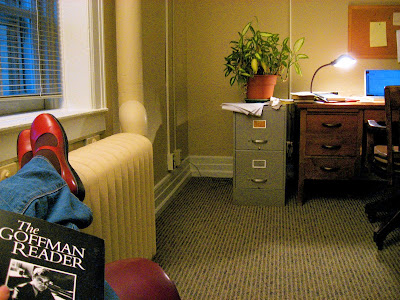 Your humble correspondent, pictured here with a lapful of vintage theory, 21 months ago in Fellowship City office.
I started the introduction to this book MS almost two years ago, back when I had to give a presentation at Fellowship Institute (see here and here for the tale, and here for my realization that it actually was the introduction that I had been writing). It's gone through some changes: a lot of the gratuitous theory references have been moved to the footnotes, and are only alluded to in the text. I've added more concrete background for the nonspecialist. And since most of the chapters took their final shape only after I had written my presentation, there were a lot of changes.
Still, today I read over my introduction, and I was taken back to about 21 months ago, when these ideas were new, and I was having epiphanies left and right. Some of them turned out to be very important; others, less so. But that ongoing wrestling with the big ideas was just that: ongoing. The thought of the journey from there (and even further back) to here, one week before submission, has got me feeling a bit reflective. So expect a few more navel-gazing posts over the next couple of weeks.
 Your humble correspondent, pictured here with a lapful of vintage theory, 21 months ago in Fellowship City office.
Wednesday, August 12, 2009
How (not) to write your conclusion
I have, against all odds and expectations, written a book that is over 90,000 words long, including notes and bibliography. For me, that's something, considering that I've yet to have an article crack 20 pages in print. In fact, the bibliography alone for this book project is longer than any paper I ever wrote in grad school. I write short.
 But one part of this whole project has been eluding me: the conclusion. I hated writing the conclusion to my dissertation, and it was only there because it had to be. Same thing with the conclusion to the manuscript I submitted to Press back in September: I wrote the conclusion-shaped object at the end in a 36-hour period, desperate to get it out the door 48 hours before my tenure file was due. As one of my readers said: "This is a strong book with a very weak conclusion." Well, yeah.
But now, with my deadline approaching,** I need a conclusion. A real one. I've known that since September. But here's how I managed not to write one:
1. September - April: Tell self that conclusion can't be written until I hear back from readers
2. April - May: I have readers' reports, but now need to write revisions. Once those are done, I'll know what it is I'm concluding about. But I can't begin the revisions until I get through this semester then get back from all my summer travel.
3. June - mid-July: Summer travel.
4. Mid-July - mid-August: Revisions. Chapter conclusions. Rewrites.
About a week ago, I decided that, with the deadline close enough to touch, I really couldn't put it off any longer. Still, "outline conclusion" remained on my "Three things" list for a couple of days. Yesterday, in the final hour before putting myself to bed, I managed to toss of a desultory couple of bullet points.
But this morning was different. This morning, I got up, took my computer to the coffee shop at 7:15, sat down, and asked myself, "What do I know about this project right now?" No peeking at last night's notes, or the manuscript as a whole. What do I know?
And I started to write. And 90 minutes later, I had 700 words. Then I added 700 of the best words from the conclusion-shaped object, and 200 from last night's bullet points. And all of a sudden, unexpectedly, I have a draft. It will need revision, of course, but it's going to be a fine place to start. Ten months of dread, procrastination, and avoidance, all taken care of in under two hours. So here's this blog entry's thesis statement:
JUST WRITE.
**Oh, for those of you who may have been wondering, I did indeed ask my editor for a one-week extension, and he granted it, no problem. So my conclusion and I have a bit of breathing room.
 But one part of this whole project has been eluding me: the conclusion. I hated writing the conclusion to my dissertation, and it was only there because it had to be. Same thing with the conclusion to the manuscript I submitted to Press back in September: I wrote the conclusion-shaped object at the end in a 36-hour period, desperate to get it out the door 48 hours before my tenure file was due. As one of my readers said: "This is a strong book with a very weak conclusion." Well, yeah.
But now, with my deadline approaching,** I need a conclusion. A real one. I've known that since September. But here's how I managed not to write one:
1. September - April: Tell self that conclusion can't be written until I hear back from readers
2. April - May: I have readers' reports, but now need to write revisions. Once those are done, I'll know what it is I'm concluding about. But I can't begin the revisions until I get through this semester then get back from all my summer travel.
3. June - mid-July: Summer travel.
4. Mid-July - mid-August: Revisions. Chapter conclusions. Rewrites.
About a week ago, I decided that, with the deadline close enough to touch, I really couldn't put it off any longer. Still, "outline conclusion" remained on my "Three things" list for a couple of days. Yesterday, in the final hour before putting myself to bed, I managed to toss of a desultory couple of bullet points.
But this morning was different. This morning, I got up, took my computer to the coffee shop at 7:15, sat down, and asked myself, "What do I know about this project right now?" No peeking at last night's notes, or the manuscript as a whole. What do I know?
And I started to write. And 90 minutes later, I had 700 words. Then I added 700 of the best words from the conclusion-shaped object, and 200 from last night's bullet points. And all of a sudden, unexpectedly, I have a draft. It will need revision, of course, but it's going to be a fine place to start. Ten months of dread, procrastination, and avoidance, all taken care of in under two hours. So here's this blog entry's thesis statement:
JUST WRITE.
**Oh, for those of you who may have been wondering, I did indeed ask my editor for a one-week extension, and he granted it, no problem. So my conclusion and I have a bit of breathing room.
Friday, August 7, 2009
On Deadlines
I have one week left to deadline. By that time, I will have finished with my to-do list (see "three things" in the sidebar for daily updates, if you're so inclined). But what I'd really like is another week to let the whole thing sit, then go over it again one more time. So I'm asking all you academic book authors out there: Did you meet your deadline? Did you ask for an extension?
Just how "dead" is that line?
Just how "dead" is that line?
Sunday, August 2, 2009
Making a List; Checking it Twice**
Just now, I created a document called "Revisions Checklist," to gather into one place exactly what still needed to be done. It's distressing to note that the list still includes items like "Write New Conclusion" at this late date. On the other hand, I'm encouraged by the fact that the list fits onto a single page, with room to spare.
Still, blogging is likely to be limited to the briefest of posts for the next couple of weeks, unless something truly interesting happens, and responses to e-mail will be on an emergency-only basis.
Oh, yeah: and I'm backing things up twice a day now.
**Actually, I'll probably be lucky if I have time to check it even once, much less twice.
Still, blogging is likely to be limited to the briefest of posts for the next couple of weeks, unless something truly interesting happens, and responses to e-mail will be on an emergency-only basis.
Oh, yeah: and I'm backing things up twice a day now.
**Actually, I'll probably be lucky if I have time to check it even once, much less twice.
Subscribe to:
Posts (Atom)